Your AI ships it.
The assistant that wrote the app can also put it live. Manifest in, URL out — with the database bound, the login wired, the secrets set, and a fuse instead of a surprise invoice. On the edge, in every region, from one sentence.
$15 a month, and it isn't just this app — every Parsons product is on the same subscription. Cancel any time. The fuse: past the allowance we turn the app off. We do not turn the meter up. No host has ever produced a six-figure invoice this way, and this one can't.
Manifest in. URL out. Already wired.
Describe the app.
A name, the code, what it needs — a database, a login, a secret or two. Your AI writes the manifest; you don't.
Ship the invoice app. It needs the Postgres and the Stripe key.name: invoice-lens
bind:
database: invoices
auth: parsons
secrets: [STRIPE_KEY]Paste one link into your AI.
Your account comes with one private address. Paste it into Claude, ChatGPT or Cursor once, and Deploy's tools are there. No AI of your own? The console has chat built in.
https://mcp-hub.parsons.ai/p/prof_••••••••/mcpShip it.
One call. It comes up on the edge at a URL every app gets — invoice-lens.parsonsapps.com — with the database bound, login wired and secrets set. Add your own domain when you're ready.
Deploy it.deployinvoice-lens · v1live in 11sbind_databaseinvoicesdoneset_secretSTRIPE_KEYsetadd_hostnameinvoices.acme.comDNS readyWatch it, and set its ceiling.
Requests, CPU, errors, logs. And a limit below the plan's, per app, so a spike disables the app instead of billing you for it.
Cap it at 200,000 requests a month and tail the logs.Hosting for apps an AI wrote.
Apps, on the edge
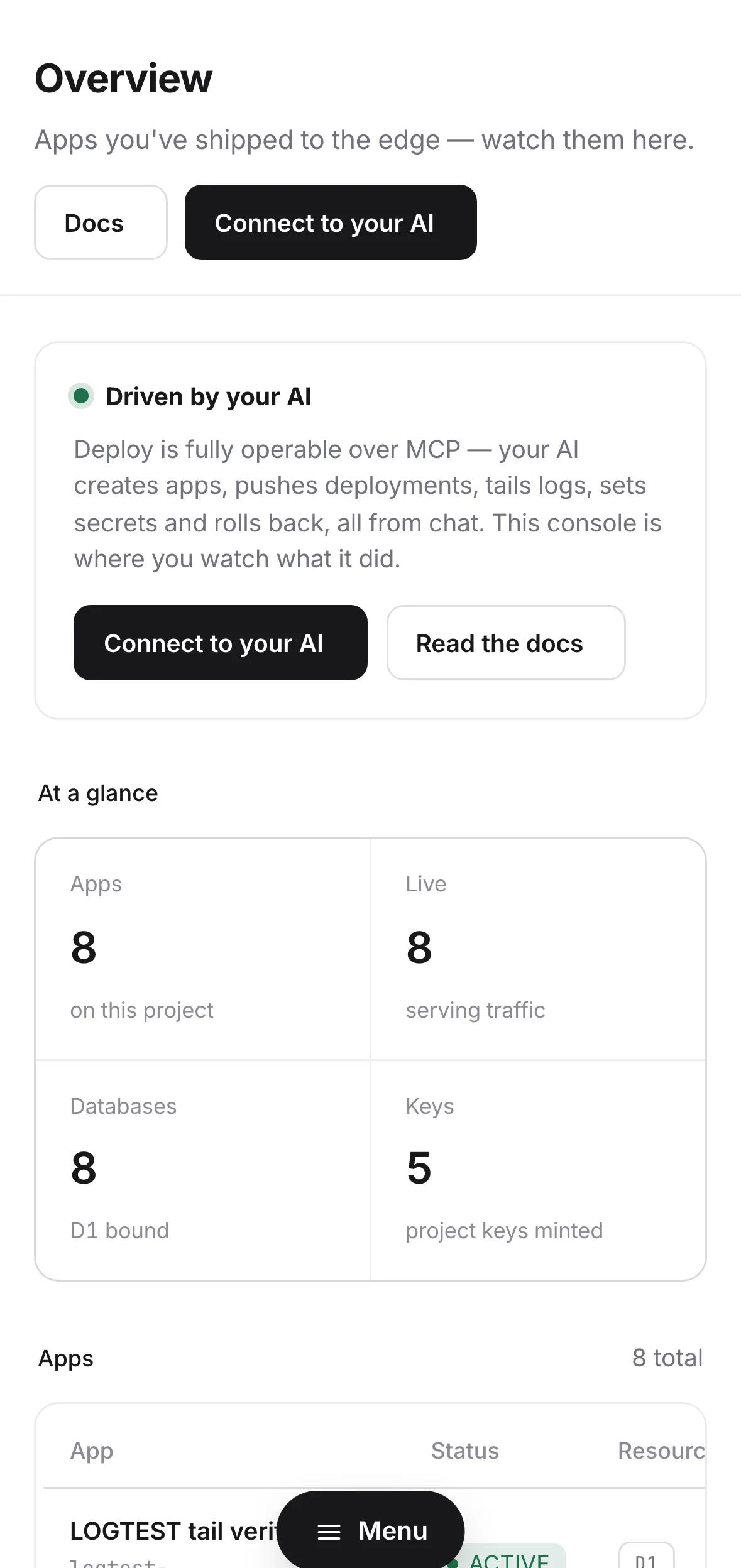
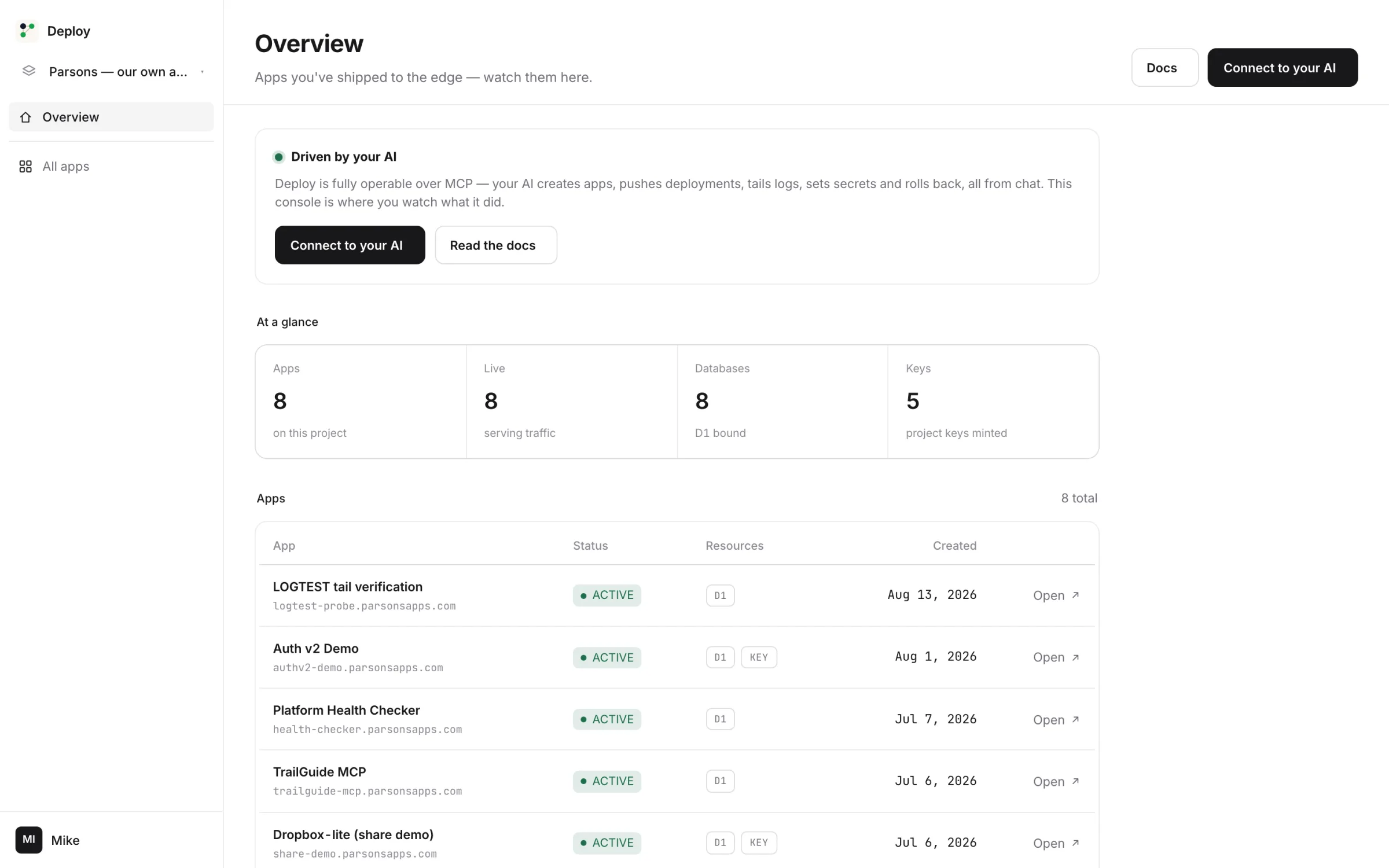
Each app at its own URL, in every region, with versions you can roll back. Eight here, on one account.
bind_databaseinvoicesboundbind_authparsons loginwiredset_secretSTRIPE_KEYsetWired on the way up
A database from Database, a login from Auth, secrets from the vault. Bound at deploy, not configured afterwards.
A URL every app gets, or your own
The parsonsapps.com hostname is free and instant. Add a domain you own, or buy one from Domains at cost plus $4.
An allowance you can see
1,000,000 requests a month included, account-wide. The gauge is on the console; the number is on this page.
set_limitsinvoice-lens · 200,000 / mosetstatusat limitdisabled, not billedThe fuse
Your own ceiling, below the plan's. Past it the app is turned off. The meter is never turned up.
Logs your AI can read
Tail the logs, ask why it failed, get the fix. The assistant that wrote the app can read its own errors.
It ships your app. It cannot run up your bill.
- ×Meter you past the allowancePast the limit the app is disabled. Overage draws only from credits you loaded on purpose.
- ×Half-disable an appEvery lifecycle operation fans out to all of an app's hostnames, custom domains included.
- ×Reach another project's database or secretsBindings are per project. An app in one project cannot be bound to another's data.
- ✓Deploy, roll back, add hostnames, set secrets, bind services
- ✓Read logs, metrics and errors
- ✓Set limits per app, below the plan's
There is no security slogan on this page and no badge we haven't earned. Everything in that list is a thing you can check; the full mechanism and every tool are on the details page.
Fifteen dollars a month — and it isn't just this app.
Is it worth it? Start where we look worst.
A hobby app on a free tier costs nothing, and we're not going to beat that. Here's what the hosts publish for the first paid tier.
Ours is $15 for the whole account — no seats — and the same $15 is the database, the login, the domain wiring and the scheduler the app needs, which on the hosts above are four more line items. And there is no free tier because a free tier is where the surprise invoice lives.